

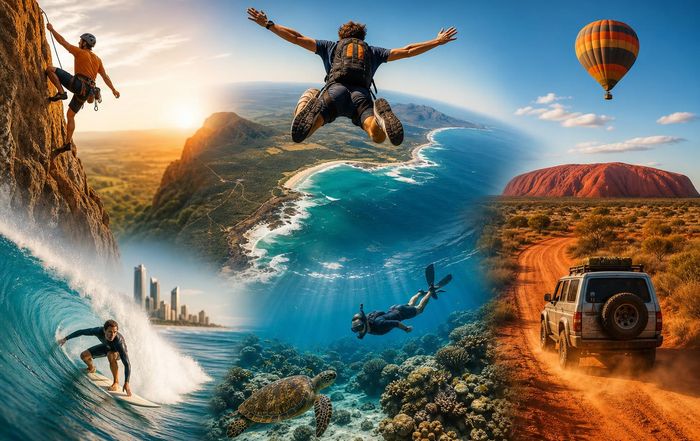
Adventure Sports Experiences Across Australia: From Reef Breaks to Red Desert
Australia's scale and variety make it one of the most diverse adventure playgrounds on the planet. Within a single trip you can surf world-class breaks, free-dive with sharks, hike alpine ridges, and launch yourself from cliffs or planes over some of the world's most recognisable landscapes. For travellers who prioritise sports, performance, and wild places, it is hard to find a more concentrated dose of adrenaline and scenery.
This guide explores key adventure sports experiences across Australia's major regions, how to approach them safely and sustainably, and what to know before you go. It is written for people who want more than a bucket list: those looking to understand conditions, culture, and the practicalities of turning big-sky dreams into real-world itineraries.
Along the way, you will find pointers to safety and performance resources, plus links to destinations and themes that connect naturally with broader interests in sports, adventure, travel, destination, and safety.
Surfing Australia's coasts: from learner beaches to heavy reefs
Surfing is woven into Australian coastal culture, from school kids on foam boards to professionals on the World Surf League. The country's coastline stretches more than 34,000 kilometres, and while not every stretch breaks perfectly, there are few places on Earth with so many surfable options.
On the east coast, New South Wales and Queensland are the most accessible starting points. Iconic breaks such as Bondi, Manly, and Byron Bay offer consistent waves and a deep ecosystem of surf schools and board rentals. The Gold Coast's Snapper Rocks and Burleigh Heads are legendary among performance surfers, though they can be extremely crowded when the sandbanks and swell align. Surf forecasts from tools like Surfline and Magicseaweed help visitors time sessions and choose suitable breaks for their level.
On the west coast, Western Australia offers rawer, less populated surf, but also higher consequences. Spots near Margaret River host elite competitions and are known for powerful reef breaks, strong rips, and shark presence. The Surfing WA and Surfing Australia organisations offer coaching pathways and safety guidance, and their resources are worth reading before paddling out in unfamiliar conditions. For beginners, sheltered beaches around Perth and Rottnest Island can be far more forgiving than the state's more famous heavy-water spots.
The southern coastline, particularly around Victoria's Bells Beach and Torquay, is shaped by the Southern Ocean. Swells can be large and water temperatures cold, even in summer. Wetsuits are essential, and understanding hypothermia risk and surf etiquette is as important as wave selection. The Surf Coast Shire Council and Surfing Victoria publish local safety and environment information, including seasonal hazards and marine life considerations.
For visitors planning a surf-centric trip, it is worth combining performance goals with a broader sense of place. Many surf towns are gateways to rich local culture, from Indigenous coastal heritage to contemporary music and food scenes, which can deepen the experience beyond the next set wave.
Diving and snorkelling: from the Great Barrier Reef to temperate kelp forests
Underwater, Australia is just as intense. The Great Barrier Reef is the most famous site, but the country also offers world-class temperate diving in the south and shark encounters off the west coast.
The Great Barrier Reef Marine Park Authority (GBRMPA) manages a vast protected area stretching over 2,300 kilometres. Many operators run day trips and liveaboards from Cairns, Port Douglas, and the Whitsundays, catering to both snorkellers and certified divers. GBRMPA's official site provides up-to-date information on reef health and zoning, including no-take and restricted areas that visitors should respect. Coral bleaching events in recent years mean conditions can vary significantly between locations; reputable operators will be transparent about which reefs are currently in good shape.
For more advanced divers, Ningaloo Reef in Western Australia offers seasonal encounters with whale sharks and manta rays. The Australian Government's Parks Australia site outlines regulations for Ningaloo Marine Park, including rules around swimming with large marine animals. These tours are heavily regulated to limit stress on wildlife, and choosing licensed operators is both a safety and ethics issue.
Temperate-water enthusiasts should not overlook southern sites such as South Australia's leafy sea dragon habitats or Tasmania's kelp forests. These environments demand thicker exposure protection and sometimes drysuit training, but reward divers with unique species and fewer crowds. Agencies such as PADI and SSI maintain updated cold-water diving guidelines that can help travellers prepare for thermal and equipment challenges.
Across all regions, diving is a sport where safety margins matter. The Divers Alert Network (DAN) provides evidence-based resources on decompression illness, fitness to dive, and emergency protocols, and many Australian operators require proof of recent diving or a refresher course for lapsed certifications. Travel insurance that covers decompression treatment and evacuation is strongly recommended, particularly in remote areas where hyperbaric chambers may be hundreds of kilometres away.
Climbing, canyoning, and vertical adventures
Australia's rock and canyon landscapes offer a wide range of technical challenges, from sandstone trad routes to deep slot canyons and big wall experiences. These are sports where local knowledge, weather awareness, and route choice are critical.
Just a few hours from Sydney, the Blue Mountains are one of the country's premier climbing and canyoning destinations. Sandstone cliffs provide thousands of routes, from single-pitch sport climbs to long multi-pitch adventures. Canyoning here ranges from relatively straightforward descents with short abseils and swims to committing technical canyons with high flash-flood risk. The New South Wales National Parks and Wildlife Service maintains detailed access and safety information for the Blue Mountains, including seasonal closures, weather alerts, and canyon conditions.
Further south, Mount Arapiles in Victoria is renowned in global climbing circles for its concentration of high-quality trad routes. It is a place where climbers can progress from moderate grades to serious multi-pitch lines, but also where poor gear placements or underestimation of route seriousness can have consequences. The Australian Climbing Association and local clubs publish bolting and ethics guidelines, emphasising minimal impact and respect for traditional climbing styles.
For travellers without advanced rope skills, guided experiences are the safer entry point. Licensed operators must comply with state adventure activity standards, and reputable companies will be transparent about qualifications, ratios, and contingency plans. The Outdoor Council of Australia and state-based bodies outline Adventure Activity Standards that operators should meet or exceed, and asking providers how they align with these benchmarks is a reasonable pre-booking question.
Vertical sports in Australia often intersect with sensitive environments and Indigenous cultural sites. Many crags and canyons have routes or areas that are voluntarily avoided out of respect for Traditional Owners' wishes. Local guidebooks, climbing forums, and national park signage are key tools for understanding where climbing is appropriate and where it is not.
Skydiving, paragliding, and aerial perspectives
If jumping off things is your preferred route to adrenaline, Australia offers a spectrum from tandem skydiving over beaches to advanced paragliding in alpine thermals. Air sports are among the most tightly regulated adventure activities in the country, and understanding that regulatory environment can help visitors make informed choices.
Tandem skydiving is widely available along the east coast, with popular drop zones at Mission Beach, Airlie Beach, Byron Bay, and near major cities such as Sydney and Melbourne. Operators are overseen by the Australian Parachute Federation (APF), which sets training standards and safety requirements. The APF website explains how tandem skydiving is regulated and what qualifications instructors must hold, and it is worth confirming that any operator you consider is APF-affiliated.
Paragliding and hang gliding are governed by the Sports Aviation Federation of Australia (SAFA). Sites such as Bright in Victoria's Alpine region, Stanwell Park south of Sydney, and various coastal cliffs in Queensland and Western Australia attract pilots for both coastal soaring and inland thermalling. SAFA's site guide and pilot information outline rating requirements for different sites, launch protocols, and no-fly zones, which are especially important near airports and controlled airspace.
For visitors, tandem paragliding flights offer a way to sample the sport without years of training. However, wind and weather windows can be narrow, and cancellations due to conditions are common. A flexible schedule and willingness to reschedule are part of the experience. It is also critical to follow pilot instructions on launch and landing, as most accidents in tandem flights occur at these low-altitude phases rather than mid-air.
These aerial experiences are more than just adrenaline hits; they provide a unique vantage point on Australia's landscapes, from reef-fringed coasts to patchwork farmland and mountain ridges. Combining them with more grounded lifestyle exploration-local food, music, and culture-can turn a single jump or flight into a richer travel narrative.
Outback expeditions: trekking, 4WD, and desert endurance
Away from the coasts, the Australian interior offers a different kind of adventure: psychological and logistical as much as physical. Long-distance hikes, 4WD expeditions, and desert runs demand planning, risk management, and respect for heat and remoteness.
The Larapinta Trail in the Northern Territory, running roughly 223 kilometres along the West MacDonnell Ranges, has become a benchmark multi-day trek. The Northern Territory Government provides detailed trail notes, water point information, and safety guidance that should be considered non-negotiable reading. Temperatures can swing from near freezing nights to extreme daytime heat, and water carries between tanks can be long. Many travellers opt for supported treks that provide logistics, food drops, and emergency communication.
In Western Australia and South Australia, remote 4WD routes such as the Canning Stock Route or Simpson Desert crossings are as much about navigation and vehicle management as scenery. The Royal Flying Doctor Service and State Emergency Services consistently warn that underprepared visitors underestimate distances and overestimate mobile coverage. Satellite communication devices, redundant water supplies, and realistic turnaround plans are essential, not optional. The Australian Government's Outback travel safety advice summarises baseline precautions for desert travel.
Running and cycling events in the outback, from ultra-marathons to gravel races, are growing in popularity. Event organisers typically provide detailed heat management and hydration protocols, and participants should treat these as minimums rather than targets. Acclimatisation, pre-event medical checks, and honest self-assessment of fitness are particularly important in high-heat environments where emergency response may be hours away.
For travellers who want the feel of the outback without full expedition risk, shorter guided walks, cultural tours with Traditional Owners, and day-trip 4WD experiences around hubs like Alice Springs or Uluru-Kata Tjuta National Park can provide a powerful taste of desert landscapes while staying within more controlled safety envelopes.
Mountain biking, trail running, and high-country escapes
Australia is often imagined as flat and dry, but its alpine and forested regions support a thriving off-road scene. Purpose-built mountain bike parks, long-distance hiking tracks, and technical trail-running routes span multiple states.
In Tasmania, destinations like Derby and Maydena have become international draws for gravity-focused riders. The Blue Derby network, developed in partnership with local government, offers a mix of flow trails and technical descents, with shuttles and hire bikes readily available. The Tasmanian Parks and Wildlife Service provides guidance on shared-use trails and environmental protection, important as visitor numbers increase and erosion and trail conflict become more pressing issues.
On the mainland, Victoria's High Country and New South Wales' Snowy Mountains transition from ski fields in winter to biking and running playgrounds in the warmer months. Long climbs, high-altitude weather volatility, and fast-changing conditions demand layering systems and route planning more associated with European alpine travel than stereotypical Australian heat. The Australian Alps National Parks resources outline weather, navigation, and emergency considerations that apply across state boundaries.
Trail running events, from short vertical-kilometre challenges to 100-kilometre ultras, have proliferated. These races often cross sensitive alpine ecosystems where off-trail shortcuts can cause disproportionate damage. Many organisers work closely with land managers to limit environmental impact, and participants can contribute by following leave-no-trace principles and respecting course markings and cut-off times. For those training independently, local running clubs and park authorities are valuable sources of up-to-date information on track closures, fire danger, and seasonal hazards like snow bridges or swollen creek crossings.
For travellers who prefer self-guided exploration, combining trail-based sports with regional food and wine-particularly in places like the High Country, the Adelaide Hills, or Tasmania-offers a way to balance performance with recovery and cultural immersion.
Wildlife, risk, and reality: staying safe in Australia's wild places
Popular culture often exaggerates Australia's dangers, focusing on sharks, snakes, and spiders. In practice, the most significant risks to adventure travellers are usually more mundane: heat stress, dehydration, vehicle accidents, surf conditions, and poor decision-making.
The Royal Life Saving Society - Australia and Surf Life Saving Australia publish detailed drowning and coastal safety statistics showing that rip currents and unpatrolled swimming are major contributors to fatalities. For adventure sports participants, understanding basic coastal safety-swimming between the flags, reading rip patterns, respecting "beach closed" signs-is as important as sport-specific skills. Many surf schools and coastal visitor centres now integrate rip-current education into their briefings.
In the bush and outback, heat illness and getting lost are recurring themes in incident reports. State emergency services and bushwalking clubs emphasise three core pillars: realistic route choice, navigation competence, and communication. The Australian Hiking community and resources like Bushwalking NSW safety guidelines provide practical checklists that apply equally to international visitors and locals.
Wildlife encounters are usually manageable with basic precautions. The Australian Museum and state health departments maintain up-to-date information on venomous animals and first aid, while shark risk is mitigated through a mix of technology, behaviour (avoiding murky water at dawn and dusk, not swimming near baitfish schools), and local advisories. Several states operate real-time shark sighting apps that water users can consult before entering the ocean.
The overarching principle is that risk in Australian adventure sports is rarely random. It is usually a function of exposure, preparation, and choices. Engaging with local knowledge, respecting weather and fire warnings, and building in margins-extra water, conservative turnaround times, backup navigation-go a long way towards ensuring that adrenaline does not slide into emergency.
Ethics, environment, and Indigenous perspectives
Adventure sports in Australia unfold across landscapes that are not just playgrounds but homelands and ecosystems under pressure. Climate change, coral bleaching, bushfires, and biodiversity loss are reshaping many of the environments adventure travellers come to experience.
The Great Barrier Reef, for example, has undergone multiple mass bleaching events linked to marine heatwaves. GBRMPA's Outlook Reports outline the cumulative pressures on the reef, from warming seas to poor water quality. Visitors can minimise their footprint by choosing eco-certified operators, avoiding reef-damaging sunscreen ingredients (such as some oxybenzone formulations), and following no-touch, no-take guidelines around coral and marine life.
On land, the Leave No Trace Australia organisation promotes seven principles adapted to local conditions, including fire management, waste disposal, and respect for cultural sites. With increasing visitation to national parks, small individual decisions-staying on trails, packing out rubbish, not building new fire rings-scale into meaningful collective impact.
Indigenous perspectives are central to any ethical framing of Australian adventure. Many of the country's most dramatic landscapes, from Kakadu to Uluru-Kata Tjuta, are jointly managed by Traditional Owners and government agencies. At Uluru, for instance, the climb has been permanently closed in recognition of its cultural significance to the Anangu people, with visitors encouraged instead to engage with guided walks and cultural experiences that explain Tjukurpa (Anangu law and stories). The Parks Australia site provides background on joint management and cultural protocols.
For adventure travellers, incorporating Indigenous-led tours, art centres, and cultural briefings into itineraries is not just a gesture of respect; it often leads to deeper understanding of country, seasons, and ecological relationships that enrich the sporting experience itself.
Planning an Australian adventure sports itinerary
Designing an adventure-heavy trip to Australia is an exercise in trade-offs. Distances are vast, seasons invert for visitors from the northern hemisphere, and weather windows vary by sport and region.
For surf-centric journeys, late autumn and winter can bring more consistent swells on the east and south coasts, but also cooler water and storm systems. Reef diving in the tropics is often best outside the wettest months and stinger season, when box jellyfish risk is highest; local tourism boards and health departments provide seasonal guidance for Queensland beaches and reef trips. Alpine sports, including backcountry touring and winter mountaineering, hinge on snow conditions that can fluctuate significantly year to year.
Logistics also matter. Budget airlines connect major cities, but many of the most rewarding adventure zones-remote reefs, outback trails, small mountain towns-require additional drives or regional flights. Balancing high-adrenaline days with rest and cultural exploration can help avoid overuse injuries and burnout, especially on longer trips. It can also create space to engage with local communities, from surfboard shapers and guides to Traditional Owners and conservation workers, who often hold the deepest knowledge of place.
For readers interested in broader perspectives on adventure, performance, and the business and ethics of outdoor travel, related coverage on performance, innovation, world, business, and ethics offers additional angles-from gear technology to conservation economics and responsible tourism models.
Australia rewards those who approach it as more than a backdrop for Instagram moments. Treated as a living, changing environment-and as Country with deep cultural roots-it becomes a place where adventure sports are not just about personal limits, but about how humans move through powerful landscapes with skill, humility, and care.