

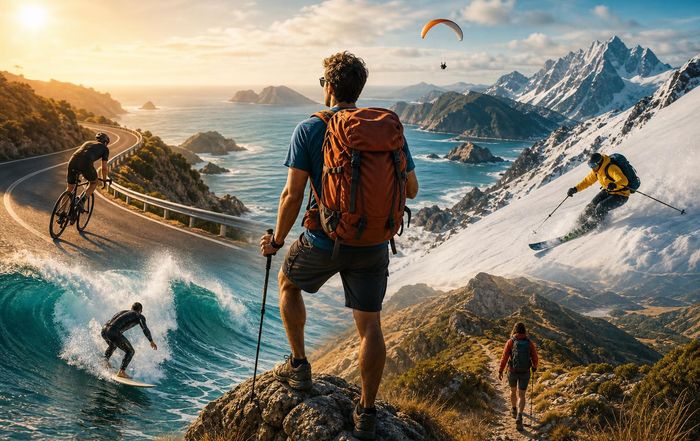
How Sports Travel Is Rewriting Modern Adventure Culture
Adventure once meant picking a place on the map and seeing what happened on arrival. Today, for a growing share of travelers, the destination is chosen for a race, a match, a climb, a wave, or a summit. Sports are no longer a side activity on holiday; they are the primary reason to move.
From amateur marathons in remote deserts to surf retreats in Indonesia, ski-touring camps in the Alps, and padel weekends in Spain, "sports travel" has become one of the most dynamic corners of global tourism. It is reshaping how people plan trips, how destinations market themselves, and how adventure culture itself is defined.
This article looks at what is driving that shift, how it is changing behavior on the ground, and what it means for safety, performance, lifestyle, and the business of travel.
From Spectators to Participants: A New Center of Gravity
For decades, sports tourism was dominated by spectators: fans flying to the Olympics, the FIFA World Cup, the Super Bowl, or Formula 1 races. That market is still powerful, but the fastest growth is now in participation-based travel.
The World Tourism Organization (UNWTO) and World Travel & Tourism Council (WTTC) have both highlighted sports tourism as one of the most resilient and fast-growing segments of global tourism, with participation events-from cycling gran fondos to mass marathons-playing a central role. Cities from Valencia to Cape Town now treat major races as core destination assets, not just one-off events.
This represents a cultural shift. Adventure is no longer framed only as wilderness exploration or classic backpacking. It is increasingly structured around:
Personal performance goals (finishing a first ultramarathon, climbing a specific grade, surfing a particular reef break).
Timed events and organized competitions.
Training camps and "bootcamps" that blend coaching, recovery, and travel.
For many travelers, the trip itself becomes a chapter in a longer performance journey rather than an isolated holiday. That mindset is changing what people look for in destinations, and how they define a successful adventure.
For readers interested in how this intersects with broader adventure and performance trends, the dedicated sections on sports, adventure, and performance offer additional context.
Data, Devices, and the Rise of "Quantified" Adventure
Technology has quietly rewired sports travel. The same tools that transformed everyday training-GPS watches, power meters, wearables, and route-planning apps-now shape how people move through unfamiliar terrain.
Platforms such as Strava, Komoot, AllTrails, and Fatmap (now integrated into Strava) allow travelers to download curated routes, analyze elevation profiles, and benchmark their efforts against global leaderboards. According to Strava's own annual Year in Sport reports, international "heatmaps" of activity clearly show how popular travel destinations function as outdoor training hubs, from Chamonix to Queenstown.
This has several knock-on effects:
First, it lowers the barrier to independent adventure. A visiting cyclist can land in Girona or Boulder and immediately access hundreds of local routes with difficulty ratings, surface types, and community comments. Runners can find safe loops and trail segments in unfamiliar cities. That accessibility feeds into the broader expansion of destination-focused travel built around sport.
Second, it changes motivation. Many travelers now plan trips around iconic segments-famous climbs like Alpe d'Huez, well-known trail loops in the Dolomites, or classic surf breaks catalogued on platforms like Surfline. The objective is not just to visit but to "tick off" specific performance milestones.
Third, it can create safety gaps. Navigation apps can give a false sense of security in remote or high-risk environments. Mountain rescue organizations in Europe and North America have warned that overreliance on smartphones and crowdsourced routes can lead to underprepared visitors attempting terrain beyond their skills. Agencies such as the American Alpine Club and UIAA (International Climbing and Mountaineering Federation) have issued guidance on prudent route selection and risk assessment, especially for visiting climbers and hikers.
As sports travel becomes more data-driven, the challenge is integrating those tools with traditional safety practices-local guides, weather knowledge, and conservative decision-making-rather than replacing them. Readers can find more on risk management in the dedicated safety section.
Wellness, Lifestyle, and the "Retreatification" of Sport
Another major shift is the blending of sport, wellness, and lifestyle into multi-day retreat formats. What began with yoga retreats and surf camps has broadened into an entire ecosystem of "active escapes": trail-running weeks in the Pyrenees, gravel cycling camps in Colorado, ski-touring and mindfulness programs in Norway, and tennis or padel weekends in southern Europe.
Several trends converge here:
First, wellness tourism itself has grown rapidly. The Global Wellness Institute has estimated that wellness tourism outpaces overall tourism growth, with travelers willing to pay a premium for trips that support physical and mental health. Sports-focused retreats fit squarely into that narrative, offering structured movement, healthy food, and digital disconnection.
Second, remote work and flexible schedules enable longer stays. Instead of a compressed long weekend, some travelers now build "workcations" around training camps, splitting time between a laptop and the mountain, ocean, or track. Destinations with strong connectivity and co-working spaces-Lisbon, Bali, Chiang Mai, various Alpine towns-have leaned into this hybrid lifestyle positioning.
Third, identity and community play a significant role. Joining a surf camp or cycling group tour connects travelers to like-minded people more quickly than traditional sightseeing, especially for solo travelers. Social media then amplifies these experiences, turning them into lifestyle markers-evidence of belonging to a global tribe of runners, climbers, skiers, or divers.
For many, this is less about peak performance and more about sustainable, meaningful living. A week of trail running and meditation, or a month of surfing and strength training, becomes a way to reset habits rather than just accumulate passport stamps. That aligns closely with broader lifestyle shifts toward health, longevity, and purposeful leisure.
The Business of Sports Travel: From Niche to Strategy
Behind the cultural shift is a significant business story. Governments, tourism boards, and private operators increasingly treat sports travelers as a strategic market segment rather than a niche.
According to studies from organizations such as the European Commission and various national tourism boards (including VisitScotland and Tourism Australia), sports tourists often:
Spend more per trip than average leisure tourists.
Travel in shoulder or off-peak seasons to align with specific events or conditions.
Stay longer when combining events with training, acclimatization, and post-event recovery.
This makes them attractive for destinations looking to smooth seasonal demand and diversify visitor profiles.
Investment follows. Cities bid for major marathons and triathlons, mountain regions develop bike parks and trail networks, and coastal areas build surf schools and kite spots with safety infrastructure. The International Olympic Committee (IOC), World Athletics, Ironman Group, and UTMB Group (for trail running) work closely with host destinations, often leaving behind improved facilities and global visibility.
However, the model is not risk-free. Over-reliance on a single flagship event can expose destinations to volatility, as seen when the COVID-19 pandemic forced mass cancellations and highlighted the fragility of event-dependent economies. Some cities have since diversified, focusing on year-round active tourism rather than just one or two high-profile dates.
For a broader view of how sport intersects with business and world trends, readers may find those sections useful.
Environmental Pressure and the Ethics of Chasing Conditions
The expansion of sports travel carries a clear environmental footprint. Many of the most sought-after experiences-heli-skiing in remote ranges, surf safaris to far-flung islands, long-haul flights for a single race-are carbon-intensive. At the same time, climate change is directly reshaping the very environments that make these adventures possible.
Research from bodies such as the Intergovernmental Panel on Climate Change (IPCC) and UN Environment Programme (UNEP) shows:
Shorter and less reliable snow seasons in many low- and mid-altitude ski areas.
Warming oceans that affect surf quality, coral reef health, and marine biodiversity.
Increased frequency of extreme weather events, impacting trail conditions, wildfire risk, and water safety.
This creates a paradox. Travelers are flying further to "catch it while it lasts," especially for snow and glacier-based sports, even as those trips contribute to the underlying problem.
In response, several initiatives are pushing for more sustainable models. Organizations such as Protect Our Winters (POW) advocate for low-carbon travel choices, policy action, and destination-level climate strategies. Some race organizers now offer incentives for train travel, introduce carbon accounting into event planning, or partner with local conservation projects.
Ethical questions are moving from the margins to mainstream discussion: Is it responsible to cross continents for a single ultra race? How should surfers balance their love of remote breaks with the emissions required to reach them? Can destinations that depend on sports tourism realistically decarbonize without losing their economic lifeline?
Adventure culture is gradually absorbing these debates. For many younger travelers, environmental values now sit alongside performance and thrill-seeking when choosing where-and how-to go. The ethics and innovation sections explore how these concerns are driving new ideas, from greener materials to different models of travel.
Safety, Risk, and the Normalization of Extreme Challenges
As sports travel has grown, so has the appetite for more extreme or technical challenges. Ultramarathons, multi-day stage races, high-altitude trekking, big-wall climbing, and advanced backcountry skiing are no longer the preserve of a tiny elite. Social media, documentaries, and influencer content have normalized them as aspirational goals for well-trained amateurs.
This democratization has upsides. It pushes people to train seriously, learn new skills, and expand their physical and psychological limits. It can also support local guiding industries and encourage investment in safety infrastructure.
Yet rescue organizations, mountain guides, and safety agencies have flagged several concerns:
Underestimation of objective risk (weather, avalanches, rockfall, ocean currents).
Overconfidence derived from gym fitness or indoor climbing experience that does not fully translate outdoors.
Inadequate acclimatization for high-altitude treks and expeditions.
Pressure to continue in unsafe conditions to "justify" the cost and effort of travel.
Reports from bodies such as the International Commission for Alpine Rescue (ICAR) and national park authorities in the United States, Canada, and Europe point to a rise in incidents involving visitors unfamiliar with local conditions.
Responsible operators and destinations are responding with mandatory safety briefings, clearer grading systems, and stricter participation criteria for certain events. Some alpine races now require proof of prior experience or completion of qualifying events. Surf schools limit access to heavy reef breaks, and dive operators enforce minimum logged-dive requirements for advanced sites.
The cultural narrative around risk is also slowly shifting. There is more emphasis on turning back, choosing easier objectives in bad conditions, and respecting local advice. For adventure culture to remain sustainable, embracing that nuance is as important as celebrating summit photos or finish-line medals. Readers can find more detailed safety perspectives in the site's safety and adventure coverage.
Local Communities, Culture, and the Double-Edged Sword of Popularity
Sports travel can bring significant benefits to local communities: off-season income, jobs in guiding and hospitality, and investment in infrastructure that residents also use. Trail networks, bike lanes, swimming facilities, and climbing gyms often serve both visitors and locals.
At the same time, rapid popularity can strain communities and ecosystems. Examples in recent years include:
Overtourism on classic long-distance trails such as the Camino de Santiago and parts of the Tour du Mont Blanc, prompting local authorities and environmental groups to discuss capacity management and trail maintenance.
Surging visitor numbers at iconic climbing areas like Yosemite, Kalymnos, and Railay, leading to crowding, waste management challenges, and debates over bolting ethics and route development.
Rapid growth in surf tourism in regions such as parts of Indonesia and Central America, which has raised questions about local access to breaks, cultural displacement, and uneven economic benefits.
Academic work in journals such as Tourism Management and Journal of Sustainable Tourism has examined these dynamics, highlighting both success stories and points of friction.
Culturally sensitive sports travel requires more than just spending money locally. It involves understanding local customs, respecting existing user groups (for example, fishers or farmers who share access points), and supporting community-led initiatives. Some destinations now promote codes of conduct for visiting athletes, while grassroots organizations work to ensure local youth have access to the same facilities that attract foreign visitors.
Adventure culture is richer when it is reciprocal: travelers bring curiosity and resources; host communities share knowledge, stories, and traditions. When one side dominates, tension follows.
Digital Storytelling and the Social Currency of Adventure
Social media has arguably done more than any other single force to accelerate the fusion of sport and travel. Platforms like Instagram, YouTube, TikTok, and Strava turn personal experiences into public narratives, often in near real time.
This has several distinct effects on modern adventure culture:
First, it elevates certain destinations and experiences into global "must-do" status. A few photogenic trails, ridges, or surf points can become worldwide phenomena, regardless of their actual capacity or fragility. Viral clips of ridge runs, big drops, or narrow aretes can drive sudden spikes in visitor numbers.
Second, it shapes expectations. Travelers may arrive with a mental image of a perfect sunrise summit or empty wave, only to meet crowds, changeable weather, and the unavoidable discomfort of real exertion. The gap between curated content and on-the-ground reality can lead to disappointment-or worse, to risky behavior as people attempt to recreate dramatic shots.
Third, it creates a new form of social currency. Completing a famous race, climbing a recognized route, or riding a legendary climb becomes not just a personal milestone but a badge within a global community. For some, this is motivating and community-building; for others, it can feel performative or pressure-laden.
Responsible storytelling is becoming part of the conversation. Some athletes, guides, and creators now highlight failure, bad weather, or decisions to turn back, as well as the less glamorous aspects of training and travel. This more honest narrative can help recalibrate expectations and reinforce safer, more sustainable norms.
Innovation: How Gear and Infrastructure Are Expanding Possibility
Innovation in gear and infrastructure is another driver behind changing sports travel patterns. Advances in equipment, materials, and facility design have opened up environments and seasons that were previously inaccessible or uncomfortable for most people.
Examples include:
Lightweight, high-performance apparel and insulation that make shoulder-season and winter adventures more feasible and enjoyable.
Gravel bikes and wider-tire road bikes that allow riders to explore mixed-surface networks far from traditional cycling hubs.
Splitboards, tech bindings, and avalanche safety gear that have contributed to the growth of backcountry skiing and snowboarding.
Affordable, portable surf craft (soft-top boards, inflatable SUPs) that lower the barrier to entry for water-based sports.
Indoor climbing gyms and artificial wave pools that introduce people to sports before they travel, often seeding demand for outdoor experiences later.
Destinations are also investing in infrastructure with travelers in mind: purpose-built trail systems, bikepacking routes, waymarked ski-touring itineraries, and multi-sport facilities that can host both locals and visiting events. Organizations such as IMBA (International Mountain Bicycling Association) work with communities worldwide to design sustainable trail networks that balance fun, safety, and environmental impact.
Innovation is not neutral, however. Easier access to equipment and terrain can draw more people into sensitive areas faster than management systems can adapt. The same technologies that enable safer backcountry travel can also encourage riskier objectives. Balancing innovation with thoughtful regulation and education is an ongoing challenge for both industry and policymakers.
How Travelers Themselves Are Changing the Culture
Perhaps the most important force reshaping adventure culture is not technology or business but the evolving mindset of participants.
Several broad shifts stand out:
First, there is a move from "one-off bucket list" thinking toward longer-term practice. Instead of climbing one peak or running one marathon and stopping, many people now see these experiences as part of an ongoing sporting life. Travel becomes a recurring chapter in that story, not the entire plot.
Second, inclusivity is slowly improving. While barriers remain-especially around cost, race, gender, and disability-there is growing visibility for diverse athletes and travelers. Adaptive sports travel, women-led adventure groups, and initiatives to support underrepresented communities in outdoor and endurance sports are gaining ground. Major organizations, from World Athletics to national parks, have begun to address access and representation more explicitly.
Third, values are broadening. For an increasing number of travelers, the "success" of a sports trip is measured not only in times, distances, or grades, but also in connection: with local culture, with the environment, and with one's own wellbeing. That may mean choosing lower-impact travel options, combining events with volunteer work, or prioritizing trips that support community-based operators.
This shift aligns with a wider rethinking of what meaningful modern living looks like: less about accumulation and more about experience, health, and contribution. In that sense, the evolution of sports travel is both a driver and a mirror of broader cultural change.
Where Sports Travel Goes From Here
Looking ahead, several trajectories seem likely to shape the next phase of sports-driven adventure:
More integrated products that blend sport, wellness, culture, and work-think training camps that include local food education, language learning, or conservation projects.
Greater emphasis on sustainability, from low-carbon itineraries and rail-linked race calendars to stricter environmental standards for events and operators.
Continued growth in data-driven personalization, with travel packages tailored to individual training loads, recovery needs, and performance goals.
Stronger regulation and safety frameworks in high-risk environments, as authorities and organizers respond to increased participation.
Ongoing negotiation between global visibility and local control, especially in communities where sports tourism is both opportunity and pressure.
For travelers, the opportunity is to use this expanded landscape intentionally. Sports can be a powerful lens through which to explore the world: they slow people down, focus attention, and create shared language across cultures. But they also demand respect-for the body, for local communities, and for the environments that make these experiences possible.
Modern adventure culture is no longer just about where people go; it is about how and why they move. Sports travel sits at the heart of that transformation, turning personal goals into journeys, and journeys into something larger than the sum of miles, meters, or medals.