

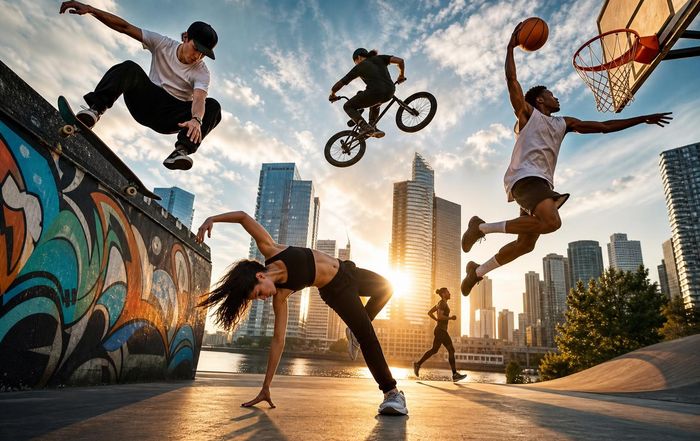
Why Urban Sports Are Becoming a Global Lifestyle Trend?
From rooftop basketball courts in Tokyo to BMX jams under Berlin rail bridges and parkour lines threading through London estates, urban sports are no longer a subcultural curiosity. They are shaping how cities look, how brands speak, and how a generation thinks about movement, identity, and public space.
Urban sports-skateboarding, BMX, parkour, streetball, freestyle football, street dance, and more-have moved from the margins to the mainstream. Their rise is not just about new hobbies; it is about a global lifestyle shift driven by youth culture, city design, digital media, and changing ideas of work, wellness, and freedom. This painstakingly written article explores why that shift is happening now, how it differs across regions, and what it means for cities, participants, and the businesses trying to keep up.
From Subculture to Center Stage
Urban sports have long histories, but their recent acceleration is striking. Skateboarding's inclusion in the Tokyo 2020 and Paris 2024 Olympic Games, alongside BMX freestyle and 3×3 basketball, signaled formal recognition that street-based disciplines are now part of global sporting culture. The International Olympic Committee framed these additions as a way to connect with younger audiences and urban communities, acknowledging that traditional stadium sports no longer monopolize attention.
At the same time, city authorities in places like Los Angeles, Paris, Barcelona, and Seoul have shifted from policing street spots to developing purpose-built skate plazas, pump tracks, and multi-use courts that mimic street terrain. The World Skate governing body coordinates events on every continent, while global brands sponsor athletes whose primary arena is a city's architecture rather than a closed venue.
This institutional recognition has not erased the DIY roots of urban sports. Many scenes still organize through local crews, informal jams, and community-built spots. But the balance has changed: what was once framed as vandalism or anti-social behavior is now widely understood as culture, performance, and even tourism value. Urban sports have become a visible part of how cities brand themselves as "creative," "youthful," or "innovative," dovetailing with broader interest in adventure, lifestyle, and destination experiences.
The City as Playground: Why Urban Environments Matter
Unlike many traditional sports, urban disciplines use the city itself as equipment. Stairs, ledges, handrails, plazas, and underpasses become obstacles, canvases, and stages. This reimagining of space is central to their appeal.
Researchers in urban design and sociology have highlighted how skateboarding and parkour offer a form of "creative resistance" to cities increasingly shaped by consumption and surveillance. A University of Brighton study on skateboarding and public space, for example, found that skaters often repurpose "leftover" or overlooked spaces, bringing life to areas that planners had not activated. Similar observations have been made about parkour practitioners, or traceurs, who use architectural features in ways never intended by designers.
For participants, this transforms routine commutes into constant exploration. A stair set is not just a route; it is a potential line. A plaza is not simply a meeting point; it is a training ground and social hub. This mindset aligns with a broader cultural shift toward experiences over possessions and an appetite for micro-adventures close to home, especially in dense urban areas where access to traditional outdoor adventure can be limited.
Cities are beginning to respond. The UN-Habitat New Urban Agenda emphasizes inclusive, accessible public spaces, and many municipalities now consult skate or BMX communities when redesigning squares and parks. Purpose-built "street-style" parks, which reproduce ledges, banks, and rails, are one outcome. Another is the formalization of informal spaces, with some cities legalizing long-used spots instead of trying to displace them.
For urban sports enthusiasts, this evolution intersects naturally with interests in travel and destination culture. Famous spots-from MACBA in Barcelona to Love Park's legacy in Philadelphia-function as pilgrimage sites, driving tourism and content creation.
Social Media, Streaming, and the New Visibility
The explosion of urban sports is inseparable from digital platforms. Where earlier generations relied on VHS tapes and print magazines, today's scenes grow through Instagram clips, TikTok edits, YouTube vlogs, and livestreamed contests.
Short-form video is particularly well-suited to street disciplines. A single trick, line, or battle can be captured in seconds and shared globally. Algorithms reward visually striking, high-skill moments, helping unknown riders or skaters gain international followings overnight. The "SkateTok" phenomenon, where skateboarding content surged on TikTok during and after the COVID-19 lockdowns, is one of the most visible examples, but similar dynamics exist for BMX, freestyle football, and street dance.
Streaming platforms have also reshaped how events reach audiences. International series like Street League Skateboarding (SLS), FISE World Series, and the Red Bull BC One breaking championship distribute highlights and full broadcasts on YouTube and social channels, making niche events accessible far beyond their physical venues. This digital reach has helped urban sports cross borders quickly, allowing styles, trends, and even local slang to circulate globally.
At the same time, creators and athletes increasingly operate as their own media channels. Sponsorship deals now often factor in social metrics alongside contest results, and many athletes build careers around content, coaching, and collaborations. This shift ties urban sports into the broader creator economy and influences how brands, media, and even employers perceive street-based skills and identities.
Health, Freedom, and the New Fitness Mindset
Urban sports align closely with changing attitudes toward health, performance, and motivation. Instead of structured drills, fixed schedules, and formal competition ladders, they offer open-ended progression, self-expression, and community-led learning.
Public health agencies such as the World Health Organization emphasize the importance of regular physical activity for preventing noncommunicable diseases and improving mental health. Yet many young people report feeling alienated by traditional gym culture or organized team sports. Urban disciplines offer an alternative: social, creative, and often low-cost ways to meet those activity guidelines while also satisfying psychological needs for autonomy and mastery.
Studies on skateboarding and mental health, including work supported by Skateistan and academic partners, have reported benefits such as increased resilience, stress relief, and social connection, especially among marginalized youth. Parkour practitioners often describe a heightened sense of body awareness and confidence that carries into other areas of life. Street dance scenes, from hip-hop to krump, have similarly been linked to emotional expression and community support.
These benefits resonate with a broader performance mindset that blends physical, mental, and social wellbeing-an area increasingly covered in performance and lifestyle media. For many participants, the goal is not medals but a sustainable, enjoyable way to move through adulthood, balancing work, study, and urban living.
Street Culture, Identity, and Belonging
Urban sports sit at the intersection of movement, music, fashion, and storytelling. They are tightly woven into streetwear, hip-hop, electronic music, and visual art, creating a cultural ecosystem that extends well beyond the act of riding or jumping.
Sociologists have long documented how skateboarding, BMX, and breaking offer alternative identities to young people who may feel excluded from mainstream institutions. Local crews function as informal support networks, transmitting not only technical skills but also codes of behavior, ethics, and style. For many, belonging to a scene provides a sense of place within a rapidly changing city.
Fashion and aesthetics play a major role. The global rise of skate-inspired brands, from Supreme to Palace, and the continued presence of labels like Vans, Nike SB, and Adidas Skateboarding, reflect how deeply street sports influence mainstream style. Collaborations with high-fashion houses, such as Louis Vuitton's work with skateboarder and designer Virgil Abloh, signal the cultural capital these scenes now command.
Music is equally central. Streetball tournaments in New York, Paris, and Manila integrate DJs and live performances. Parkour and freerunning edits often feature underground producers. Breaking's inclusion in the Paris Olympics came after decades of development within hip-hop culture, recognized by organizations like UNESCO, which has listed hip-hop elements as part of intangible cultural heritage discussions in several countries.
These cultural layers make urban sports attractive not only as pastimes but as ways of life, shaping how participants dress, speak, travel, and even choose careers. They also create rich material for culture and world storytelling, from documentaries to brand campaigns.
Safety, Risk, and the Ethics of the Street
Urban sports inevitably involve risk. Concrete, traffic, and height add layers of hazard absent from many controlled environments. This raises questions about safety, regulation, and ethics-especially as brands and platforms amplify the most spectacular, high-risk content.
Medical research on skateboarding and BMX injuries, including data from the American Academy of Pediatrics and British Journal of Sports Medicine, indicates that most injuries are minor but that head trauma and fractures are significant concerns when protective gear is not used. Parkour studies show similar patterns: high repetition and impact can lead to overuse injuries, while jumps from excessive heights carry serious risk.
Responsible practice requires a culture of risk assessment, progression, and mutual care. Many communities have developed their own safety norms-spotters for big tricks, informal coaching for beginners, and shared knowledge about which spots are too dangerous. Organizations like Parkour Earth and national skate or BMX federations publish safety guidelines, while NGOs such as Skateistan integrate child protection and trauma-informed coaching into their programs.
For cities and policymakers, the challenge is to balance freedom with protection. Banning urban sports from public space can push them into more dangerous, hidden environments, while over-regulation can strip them of their creative edge. Some municipalities now adopt harm-reduction approaches: designing spaces with fall zones, improving lighting, and working with local scenes on safety education rather than relying solely on enforcement.
Ethically, there is also the question of commercialization. When brands or media outlets profit from high-risk performances, they shoulder some responsibility for how risk is portrayed and incentivized. Responsible coverage and sponsorship increasingly mean highlighting progression, creativity, and community impact, not just viral bails or roof gaps.
Business, Brands, and the New Urban Economy
The growth of urban sports has created a complex ecosystem of businesses, from core equipment makers to global fashion houses, event organizers, and digital platforms.
At the grassroots level, skate shops, indoor parks, and community studios remain vital infrastructure. They provide physical spaces, mentorship, and local jobs, often operating on thin margins. During the COVID-19 pandemic, many such venues were hit hard, prompting support campaigns and renewed recognition of their social role.
At the other end of the spectrum, multinational brands have invested heavily. Nike's SB line, Adidas's collaborations with riders, and Red Bull's global event portfolio are high-profile examples. Streaming services and broadcasters compete for rights to events like SLS or Olympic qualifiers, while platforms such as YouTube and TikTok monetize creator content, intertwining urban sports with the broader attention economy.
For cities, urban sports can be part of economic development strategies. Major events bring tourism, media exposure, and sometimes legacy infrastructure. Studies commissioned by cities like Barcelona and Rotterdam have highlighted the economic and branding impact of being perceived as skate- or bike-friendly, complementing broader business and innovation narratives.
However, commercialization raises concerns about authenticity and access. When scenes become heavily branded, there is a risk that low-income participants are priced out, or that local cultures are overshadowed by global marketing narratives. Some communities respond by emphasizing DIY culture, independent media, and alternative sponsorship models, while others engage critically with brands to secure resources without surrendering control.
For those active people following brands and jobs in this space, new roles are emerging: content producers, community managers, event logisticians, urban sports coaches, and designers specializing in skateable or rideable architecture.
Global Spread, Local Flavors
Urban sports are now firmly global, but they do not look the same everywhere. Local cultures, politics, and geographies shape how scenes develop.
In North America, cities like Los Angeles, New York, and Montreal remain hubs for skateboarding and streetball, with strong ties to music and film. In Europe, Barcelona has become a de facto skate capital, while Paris's Olympic investments have boosted skate, BMX, and breaking infrastructure. Northern European cities, with their emphasis on cycling and public space, have seen rapid growth in BMX and freestyle scooter scenes.
Across Asia, urban sports have expanded rapidly. China's state-backed push to perform well in Olympic skateboarding and BMX has led to new facilities and training programs, while Japan's gold medals in women's skateboarding at Tokyo 2020 inspired a surge of youth interest. South Korea's strong dance culture supports thriving street dance and breaking scenes, which fed into breaking's Olympic debut.
In Latin America, countries like Brazil and Mexico combine long-standing skate and surf cultures with emerging parkour and BMX communities. Brazilian skaters and BMX riders have become international icons, supported by a passionate fan base and relatively mild urban climates conducive to year-round riding.
In Africa, growth is uneven but dynamic. South Africa's skate and BMX communities are well established, with cities like Johannesburg and Cape Town hosting international events. Grassroots projects in countries such as Ethiopia, Kenya, and Ghana use skateboarding and BMX as tools for youth development, sometimes supported by NGOs and international donors.
These regional differences underscore why urban sports cannot be reduced to a single global style. Local music, language, politics, and architecture all leave their mark, making the global scene a patchwork of distinct micro-cultures rather than a homogenized brand.
Urban Sports as a Lens on the Future of Cities
The rise of urban sports offers clues about where cities and lifestyles may be headed.
First, it reinforces the idea that public space is not just for transit or consumption but for active, creative use. As debates around "15-minute cities," car-free zones, and climate-resilient design intensify, the presence of skaters, riders, and dancers becomes a visible indicator of how welcoming a city is to informal culture and everyday adventure.
Second, it highlights the blending of physical and digital life. Urban sports exist simultaneously on the street and on screen, with participants toggling between in-person sessions and online communities. This hybrid model may foreshadow how other forms of recreation, work, and learning will evolve.
Third, it challenges traditional hierarchies in sport and culture. Success is increasingly measured not only in medals but in influence, creativity, and community impact. A local filmer documenting a city's scene can have as much cultural weight as an international contest organizer, and a builder of DIY spots can shape a city's identity as much as an architect of official parks.
For super fit readers interested in sports, adventure, and contemporary lifestyle, urban sports are a powerful lens on broader shifts in how people move, connect, and imagine their futures. They compress performance, culture, risk, and innovation into the everyday fabric of the city-turning commutes into sessions, sidewalks into stages, and neighborhoods into living, evolving playgrounds.