

How to Stay Fit During Long-Distance Travel
Long flights, overnight trains, marathon road trips and back-to-back business hops can quietly erase weeks of training and leave even active people feeling stiff, sluggish and sleep-deprived. Yet for many adventure seekers, athletes, remote workers and frequent flyers, long-distance travel is part of the lifestyle rather than an occasional exception.
Staying fit on the move is less about finding a perfect gym at every stop and more about building a simple, repeatable system that protects your mobility, sleep, circulation and basic conditioning. With a bit of planning, travel days can support your performance instead of sabotaging it.
This positive and educational content brings together current research, practical strategies and real-world routines to help you stay physically and mentally sharp on long journeys-whether you are chasing alpine routes, surf breaks, business deals or new cities.
Understand What Long Travel Does to Your Body
Long-distance travel stresses the body in several overlapping ways. Knowing the main issues makes it easier to design realistic countermeasures rather than relying on vague intentions to "move more."
Extended sitting-common on flights over four hours, long-haul buses or road trips-reduces blood flow in the legs and tightens hip flexors, hamstrings and the lower back. The World Health Organization notes that prolonged immobility is a risk factor for venous thromboembolism, including deep vein thrombosis (DVT), especially on journeys over four hours. While the absolute risk is low for healthy people, the combination of cramped seating, dehydration and inactivity can still cause swelling, discomfort and slower recovery from training.
Cabin conditions on aircraft add another layer. Commercial jets typically run at a cabin altitude equivalent of 1,800-2,400 meters (6,000-8,000 feet) with low humidity, which can contribute to mild dehydration and fatigue. The International Air Transport Association (IATA) explains that low humidity, plus alcohol and caffeine, can accelerate fluid loss in flight. Even if you drink "normally," you may land under-hydrated, which affects performance and sleep.
Jet lag is effectively a circadian rhythm disruption. Crossing multiple time zones shifts light exposure, meal timing and sleep schedules, confusing the body's internal clock. The American Academy of Sleep Medicine describes jet lag as a temporary circadian misalignment, which can reduce cognitive performance, coordination, and perceived exertion during exercise-crucial factors for adventure sports and high-stakes trips.
Finally, the travel environment itself-irregular meals, limited food options, stress, and exposure to new pathogens-can nudge people toward ultra-processed snacks, excess alcohol and poor sleep. Over a single trip this might not matter, but for frequent travelers it can become a chronic drain on health and performance.
Pre-Trip Preparation: Set Yourself Up to Win
The most effective "travel fitness hacks" start before you leave home. A small amount of planning can turn a potentially draining journey into a manageable training interruption rather than a full derailment.
First, look at your overall training schedule. If you follow a structured program for running, cycling, climbing or strength, consider aligning a deload or lighter training week with the travel window. Many endurance coaches and strength programs already use periodic recovery weeks; using your travel days for this lighter phase can reduce guilt and protect long-term progress. Readers interested in broader performance planning may also find value in exploring related guidance on training and recovery.
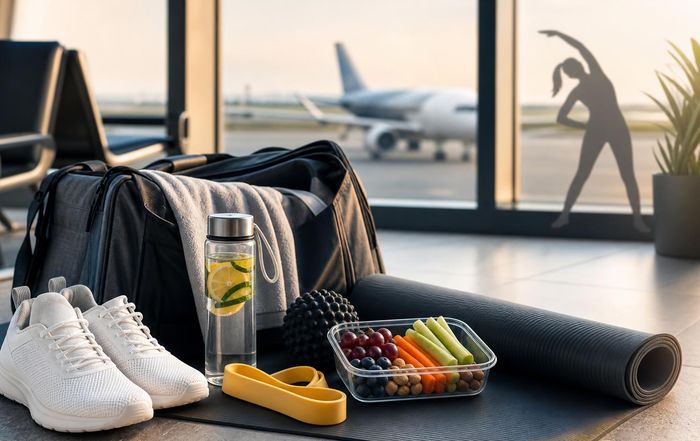
Packing intentionally supports this strategy. Simple, lightweight tools can transform a hotel room or rental apartment into a functional training space. A short resistance band or mini-loop weighs almost nothing and enables pulling movements, hip activation and shoulder work that are difficult to replicate with bodyweight alone. A compact massage ball or lacrosse ball helps release tight hips and back muscles after flights. The American Council on Exercise offers sample resistance band routines that translate well to travel.
Clothing choices matter too. Wear or pack comfortable, stretchy layers for travel days, especially on long flights, trains or buses. Restrictive waistbands and stiff fabrics make it less likely you will perform in-seat movements or stretch. If you have elevated DVT risk (previous clots, recent surgery, pregnancy or certain medications), talk to a healthcare professional about medical-grade compression stockings; the UK National Health Service (NHS) provides detailed advice on compression stockings and travel.
Finally, plan your food and hydration strategy as deliberately as your route. Packing a refillable water bottle and a small stash of higher-protein, lower-sugar snacks-nuts, jerky, oat bars, or roasted chickpeas-reduces reliance on ultra-processed airport or gas-station options. This is especially helpful if you are heading to remote adventure destinations where food choices may be limited, a topic that also intersects with our coverage of travel and destination planning.
Move More While You're in Transit
On travel days, the goal is not to "crush a workout" but to keep blood flowing, joints moving and stiffness to a minimum. Small, consistent movement breaks are more important than intensity.
For flights and trains, aim to stand and walk the aisle at least every 60-90 minutes when it is safe to do so. The Centers for Disease Control and Prevention (CDC) recommends frequent ambulation and calf exercises to reduce clot risk on journeys over four hours, especially for people with additional risk factors. Even if you cannot leave your seat, you can perform ankle circles, heel raises, toe taps and gentle knee lifts to activate the lower legs.
Drivers and road-trip passengers have different options. Plan short breaks every two to three hours-not just for refueling but for movement. A quick five-minute routine at a rest stop can include hip circles, walking lunges, arm swings and a brief forward fold to decompress the spine. These micro-sessions are particularly important if you are heading to physically demanding activities such as skiing, trekking or climbing soon after arrival; they help bridge the gap between static travel and dynamic movement. For broader adventure-sport ideas, our adventure section explores how athletes integrate movement into challenging itineraries.
Seating posture is another under-appreciated factor. While "perfect posture" is unrealistic for hours at a time, alternating positions can reduce strain. Use a small pillow or rolled-up jacket in the lumbar curve to support the lower back. Slightly reclining the seat often feels better for the spine than sitting bolt upright, as long as it does not compromise others' space or safety. Adjusting the headrest to keep the neck in a neutral position helps avoid waking up with severe stiffness.
If you are comfortable doing so, light isometric contractions-gently pressing your hands together, squeezing your glutes, engaging your core for a few breaths-can maintain neuromuscular engagement without drawing attention. These small efforts are not a replacement for real training, but they make a difference over repeated long trips.
Protect Circulation and Reduce Health Risks
For most healthy travelers, the biggest circulation concern is discomfort and swelling. For some, especially those with additional risk factors, DVT becomes a more serious issue. The aim is to keep blood moving and reduce clot risk without overreacting.
Hydration is a central piece. Dehydration thickens the blood and may increase clot risk, though evidence is mixed; in any case, it reliably worsens fatigue and headaches. Many aviation medicine sources, including the Aerospace Medical Association, recommend steady water intake and limiting alcohol and caffeine before and during long flights. A practical approach is to drink a glass of water every hour or so while awake, adjusting for body size and thirst, and to avoid heavy drinking the night before travel.
Loose, comfortable clothing and avoiding tightly crossed legs help maintain venous return. For those with known risk factors, compression stockings have evidence behind them: a Cochrane review found that properly fitted compression stockings reduced the incidence of asymptomatic DVT on long-haul flights in higher-risk populations. However, stockings are not a universal requirement, and medical advice is essential if you have cardiovascular or clotting issues.
Smoking before or during travel further constricts blood vessels and reduces oxygen delivery, compounding circulation issues. If quitting is not yet on the table, at least avoiding cigarettes for several hours before and after long flights can reduce acute strain.
Finally, consider how your arrival plans interact with circulation and fatigue. Jumping directly into high-altitude trekking, big-mountain skiing or deep technical dives after a long-haul flight adds additional physiological stress. Where possible, build a buffer day or at least a lighter first day into your itinerary, a common recommendation in responsible destination and safety planning.
Manage Jet Lag to Preserve Performance
For travelers crossing multiple time zones, especially eastward, jet lag can undermine both training and enjoyment at the destination. While you cannot eliminate it entirely, you can reduce its impact with deliberate light exposure, timing of sleep and, in some cases, carefully used supplements.
The Sleep Foundation and AASM both emphasize that timed exposure to bright light is the strongest tool for shifting circadian rhythms. As a rule of thumb, if you travel east, you generally want morning light in the new time zone to advance your clock; if you travel west, you often benefit from evening light to delay it. Tools such as the Jet Lag Rooster planner and airline partner apps incorporate research from circadian scientists like Dr. Charles Czeisler to suggest specific light schedules, though they should be treated as guides rather than strict prescriptions.
Melatonin, a hormone naturally produced at night, can help some travelers shift their sleep timing. The Mayo Clinic notes that low-dose melatonin (often 0.5-3 mg in adults) taken a couple of hours before desired bedtime in the new time zone may reduce jet lag symptoms. However, responses vary, quality control of supplements is uneven, and melatonin can interact with medications, so medical advice is wise, especially for frequent or high-dose use.
On the flight itself, set your watch to destination time when you board and loosely align your behavior with it-eating and attempting to sleep according to where you are going rather than where you came from. Short naps (20-30 minutes) can help if you are extremely tired, but long naps at the wrong time make it harder to adjust upon arrival.
Caffeine is a valuable but double-edged tool. Moderate use in the destination's morning can improve alertness, but heavy doses late in the day will delay adaptation. Athletes and adventure travelers planning early-start activities-such as alpine ascents or long bike stages-should be especially careful not to trade short-term alertness for poorer sleep quality.
Build a Minimalist Travel Workout System
Once you arrive-or even during long stopovers-you can maintain a surprising level of fitness with short, focused sessions. The key is to think in terms of movement patterns and intensity rather than specific equipment.
Most people can cover the essentials with three categories: lower-body strength, upper-body pushing and pulling, and core stability. A classic "hotel-room workout" might include squats or split squats, hip hinges (e.g., single-leg deadlifts without weight), push-ups, a horizontal pulling motion using a resistance band around a solid anchor, and a plank variation. The American College of Sports Medicine (ACSM) offers general guidelines for bodyweight and resistance training, which adapt easily to travel.
Time-efficient formats such as circuits or EMOM (every minute on the minute) keep sessions under 20-30 minutes while still providing a meaningful stimulus. For example, a 15-minute circuit of 10 squats, 10 push-ups and 10 band rows, repeated with minimal rest, can maintain muscular endurance and elevate heart rate. Two or three such sessions per week are usually enough to prevent significant strength loss over a multi-week trip.
Cardio is often easier than people expect. Brisk walking, stair climbing, short runs, or rental bikes can provide aerobic work while doubling as exploration, aligning nicely with active travel and lifestyle choices. In dense urban destinations, walking meetings or sightseeing on foot can easily accumulate 8,000-12,000 steps per day, which research associates with better cardiometabolic health.
For higher-intensity work in limited time and space, short sprint intervals-on a hotel treadmill, nearby hill, or even with bodyweight movements like squat jumps-can maintain VO₂ max and anaerobic capacity. However, these sessions place more stress on joints and soft tissue. If you are jet-lagged, under-slept or in unfamiliar terrain, err on the side of moderate-intensity steady work rather than maximal efforts to reduce injury risk.
Use Your Destination as a Training Playground
One of the advantages of long-distance travel, especially for adventure-oriented readers, is access to new terrain and activities. Instead of trying to replicate your home gym exactly, consider how the environment can expand your fitness.
In mountain destinations, hiking and trail running naturally build endurance and leg strength. Coastal areas offer open-water swimming, surfing, stand-up paddling and kayaking, which challenge balance and core stability. Urban hubs often provide public bike-share schemes, outdoor fitness parks and running paths along rivers or waterfronts. Many cities now maintain online maps of official running routes and greenways, which can be found via municipal websites or tourism boards.
Cultural activities can double as low-intensity movement. Walking food tours, museum days and city photography walks may not feel like "training," but they keep you moving for hours. For travelers interested in how sport, culture and place intersect, our culture section often highlights destinations where movement is woven into daily life.
If you practice a specific sport-climbing, surfing, cycling, martial arts-consider connecting with local clubs or guides. Organizations like the International Federation of Sport Climbing, Surfing Great Britain, or local cycling federations often list affiliated gyms and groups. Joining a group ride or a drop-in class provides structured training plus social connection, which supports mental well-being during longer trips.
The main caveat is safety. New environments bring unfamiliar traffic patterns, trail conditions, weather and water hazards. Before committing to serious efforts, gather local advice on routes, crime risk, wildlife, and emergency services. Our dedicated safety coverage dives deeper into risk management for outdoor and urban adventures.
Eat and Drink Like an Athlete, Not a Tourist (All the Time)
Food is one of the joys of travel, and rigid restriction usually backfires. The goal is not perfection but a baseline of supportive nutrition that leaves room for exploration.
A simple framework that many sports dietitians recommend is to prioritize protein, plants and hydration at each meal, then add local specialties around that foundation. The Academy of Nutrition and Dietetics suggests that active adults aim for roughly 1.2-2.0 g of protein per kilogram of body weight depending on training load. On the road, that might mean choosing grilled fish, legumes, eggs or yogurt at breakfast, adding beans or lentils to local dishes, and carrying portable options like protein bars or powdered shakes.
Fruits and vegetables support immune function, which is especially important when exposed to new microbes on planes and in crowded cities. While it may be tempting to rely on pastries and fried snacks, including at least a couple of servings of colorful produce daily can reduce the risk of catching minor illnesses that derail both training and travel plans.
Hydration remains crucial beyond the travel day itself. Climate, altitude and activity level change fluid needs; high-altitude trekking, desert exploration or tropical humidity all increase sweat loss. Sports medicine groups such as the Gatorade Sports Science Institute and ACSM provide guidance on fluid and electrolyte replacement, which may be helpful for multi-day endurance or adventure trips.
Alcohol deserves special mention. Enjoying local wine, beer or spirits is part of many travel experiences, but heavy drinking impairs sleep, recovery and coordination. For early-start adventures or important work days, it may be worth limiting intake the night before or choosing low-alcohol options.
Sleep: The Hidden Performance Multiplier
Among all the levers you can pull to stay fit on long-distance trips, sleep is often the most powerful and the most neglected. Poor sleep amplifies jet lag, increases injury risk, reduces strength and endurance, and undermines decision-making-an especially serious issue in technical sports or remote environments.
Creating a "portable sleep kit" can make a big difference. A compact eye mask, foam earplugs or noise-canceling headphones, and a familiar pillowcase or scarf can turn a noisy hotel or guesthouse into a more restful space. Sleep researchers at institutions like Harvard Medical School emphasize consistent pre-sleep routines and sleep-friendly environments as cornerstones of good rest; these principles apply on the road as well.
Try to anchor your sleep to local night-time as soon as practical, even if that means a tough first evening. Short outdoor walks in daylight, light exercise and regular mealtimes all reinforce the new schedule. Conversely, bright screens, heavy meals and intense training late at night make adaptation harder. If you must work across time zones, cluster late-night sessions into a few days rather than spreading them thinly across the entire trip, giving your body at least some fully aligned nights.
Napping can be a useful tool when used carefully. A 20-30 minute nap early in the afternoon can restore alertness without deeply resetting your internal clock. Longer naps, especially late in the day, risk creating a "second wind" that keeps you awake past midnight.
When to Ease Off-and How to Restart After the Trip
Even with good planning, there will be trips where work demands, family obligations, illness or logistics make full adherence impossible. In those cases, it is better to consciously reduce training than to cling to an unrealistic standard and feel like you have "failed."
If you are sick, severely jet-lagged or dealing with acute injury, shifting the goal from maintaining fitness to protecting health is the smart move. Light walking, gentle mobility work and extra sleep will serve you better than forcing intense sessions. Adventure and endurance communities increasingly recognize that long-term performance depends on respecting recovery and health signals, a theme echoed in many pieces in our performance and ethics coverage when discussing responsible sport and self-care.
When you return home, resist the urge to immediately "make up" for missed workouts. Instead, treat the first week back as a ramp-up phase: resume about 70-80% of your usual volume and intensity, check how your body responds, and only then climb back to full load. Research on detraining suggests that most people maintain a large portion of their fitness over two to three weeks with even minimal stimulus; what matters more is how intelligently they rebuild afterward.
Turning Travel from Fitness Threat into Fitness Asset
Long-distance travel does not have to be the enemy of fitness. With a bit of foresight, movement in transit, smart choices about sleep and food, and a flexible approach to training, trips can become opportunities to refine resilience, explore new forms of activity and return home mentally refreshed rather than physically depleted.
For those whose lives blend sport, adventure, work and global mobility, the goal is not rigid perfection but a sustainable system: one that protects health on long flights, preserves the strength and endurance you have built, and leaves enough bandwidth to enjoy the very experiences that make travel worthwhile.
People interested in applying these ideas to specific adventure sports, destinations or professional travel patterns can explore more related daily knowledge across sports, adventure, travel, world and business to shape a travel-fitness approach that fits their own journeys.