

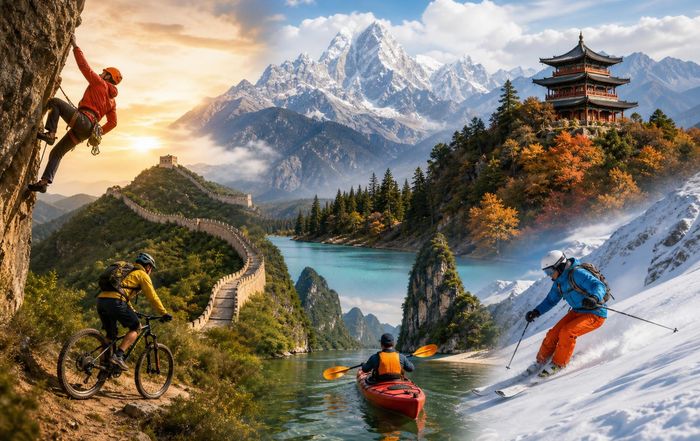
Outdoor Sports and Travel Experiences Across China
China's vast geography and rapidly growing outdoor culture make it one of the most varied adventure destinations on the planet. From Himalayan peaks on the Tibetan Plateau to subtropical reefs in the South China Sea, the country offers serious expedition objectives, accessible weekend escapes, and everything in between. For travelers who care about both the journey and the environment they move through, understanding where and how to explore China's outdoors has become as important as ticking off famous landmarks. This key overview looks at some of the most compelling regions and activities, how the outdoor scene is changing, and what visitors should know about safety, logistics, and responsible travel before setting out.
How China's Outdoor Scene Is Changing
Over the past decade, outdoor recreation in China has shifted from a niche pursuit to a mainstream lifestyle choice. According to data cited by the China Tourism Academy, domestic nature-based tourism and "sports tourism" have grown quickly, helped by rising incomes, urban stress, and government policies encouraging fitness and rural revitalization. The General Administration of Sport of China has supported development of national fitness trails, cycling greenways, and ski resorts, especially in the run-up to and aftermath of the Beijing 2022 Winter Olympics.
Those Games accelerated investment in winter sports infrastructure, particularly in Hebei and Jilin provinces, and helped popularize skiing and snowboarding among younger urban Chinese. At the same time, social media platforms such as Xiaohongshu (RED) and Douyin have turned once-obscure hiking routes and crags into viral destinations, sometimes faster than local infrastructure and environmental protections can keep up.
For international travelers, this means a wider range of commercial tours, more rental gear, and better transportation links to mountain and coastal areas than even a few years ago. It also means crowding at some "Instagram-famous" viewpoints, the need to verify safety standards for adventure operators, and a growing conversation about how to balance outdoor recreation with conservation-issues that echo debates in other global adventure hubs. People interested in the broader sports and performance context can find more related coverage in the super sports and performance sections.
High-Altitude Adventures in Western China
Western China is where the country's most dramatic mountain landscapes converge: the Himalayas, Karakoram, Pamir, and Tianshan ranges. This is the region of high-altitude trekking, big-wall climbing, and long, lonely cycling routes across high plateaus.
Tibet and the Himalayas
The Tibet Autonomous Region (TAR) offers some of China's most iconic mountain views, including the north face of Mount Everest (Qomolangma). The Qomolangma National Nature Reserve on the Tibetan side provides road access to Everest Base Camp for tourists, though rules and access can change based on environmental and political considerations. Travelers should check current regulations through official tourism channels or reputable operators, as independent travel in Tibet is heavily restricted and typically requires joining an organized tour.
The altitude is serious: Lhasa sits at around 3,650 meters, and many trekking routes and passes go significantly higher. The U.S. Centers for Disease Control and Prevention (CDC) and the International Society for Mountain Medicine provide clear guidance on altitude illness prevention and acclimatization schedules, which are highly relevant here. Even fit travelers should plan gradual ascents, rest days, and contingency time for weather or road closures.
Tibet's sacred peaks, monasteries, and pilgrimage circuits add a cultural dimension that distinguishes these journeys from purely athletic expeditions. However, visitors should understand that some mountains and lakes are considered sacred and may be off-limits to climbing or swimming. Respecting local religious customs and photography rules is not only ethical but often legally required.
Sichuan, Yunnan, and the Eastern Edge of the Himalayas
For many adventure travelers, the eastern edge of the Himalayas-sometimes called the "Three Parallel Rivers" region-is more accessible and flexible than Tibet proper. Northern Yunnan and western Sichuan feature deep gorges, glaciated peaks, and Tibetan-influenced cultures without the same level of permit restrictions.
Popular areas include:
Yading Nature Reserve in Sichuan, with its circuit trails around three sacred peaks and high-altitude lakes.
Tiger Leaping Gorge in Yunnan, one of the world's deepest river canyons, where multi-day trekking routes pass through villages and terraced fields.
The region around Shangri-La (Zhongdian), a hub for trekking, cycling, and cultural tourism.
The UNESCO World Heritage listing for the Three Parallel Rivers of Yunnan Protected Areas highlights the region's extraordinary biodiversity and geological complexity. However, rapid tourism development has raised concerns about trail erosion, waste management, and the impact of new roads and cable cars. Choosing local operators that prioritize environmental standards and supporting community-based guesthouses can help mitigate some of these pressures.
For broader destination context around such landscapes, Xdzee's destination and travel pages offer additional background on planning multi-region trips.
Rock Climbing and Via Ferrata Hotspots
China's limestone and granite formations have attracted climbers from around the world, though access and development vary widely. While the country does not yet have the same density of established climbing areas as parts of Europe or the United States, several regions have become notable hubs.
Yangshuo and the Karst Landscapes of Guangxi
The karst towers around Yangshuo in Guangxi are perhaps China's most famous climbing destination. Hundreds of bolted sport routes wind up limestone walls above the Li River, with grades to suit beginners and elite climbers alike. The town itself has a longstanding backpacker scene, with gear shops, guiding companies, and English-speaking instructors.
Climbers should be aware that access to some crags has fluctuated over the years due to land-use disputes, safety inspections, or local government decisions. The American Alpine Club and international climbing forums often share updates, but the most reliable information usually comes from local climbing gyms or guide services on the ground. Environmental considerations-especially avoiding farming areas, respecting village boundaries, and minimizing chalk and fixed gear on culturally sensitive formations-are increasingly discussed within the climbing community.
Beyond pure climbing, Yangshuo offers caving, river kayaking, and cycling through the surrounding countryside, making it an all-round outdoor hub that appeals to mixed-ability groups and families as much as hardcore climbers.
Zhangjiajie, Via Ferratas, and Scenic Walkways
The Zhangjiajie National Forest Park in Hunan, known for its sandstone pillars that inspired landscapes in the film Avatar, has become a magnet for tourists and a testing ground for more engineered forms of adventure. Glass-bottom walkways, high bridges, and via ferrata routes (protected climbing paths with fixed cables and ladders) offer vertical exposure with relatively controlled risk, assuming equipment is well maintained and properly used.
The China National Tourism Administration has issued safety standards for high-altitude tourism infrastructure, but enforcement can vary. Travelers considering such attractions should look for operators that clearly display safety certifications, maintain equipment visibly, and provide harnesses and helmets that meet recognized standards such as EN or UIAA norms. International mountaineering bodies like the UIAA provide general guidance on via ferrata safety that is applicable worldwide.
Trekking, Trail Running, and Long-Distance Hiking
Outside the dramatic peaks of the west, China offers a wide spectrum of hiking experiences-from day walks near megacities to remote multi-day routes where self-sufficiency is essential.
Classic Multi-Day Routes
Some of the better-known multi-day treks include:
High plateau routes in Qinghai and Gansu, where Tibetan culture and grassland ecosystems dominate.
The Siguniangshan area in Sichuan, often called the "Alps of the East," with valley treks and mountaineering objectives like Mount Siguniang (Four Sisters Mountain).
Sections of the Great Wall in Hebei and Beijing municipalities, where wild, unrestored segments provide rugged hiking and historical immersion.
While there is no official national long-distance trail network equivalent to the Appalachian Trail or Camino de Santiago, regional governments have been promoting "greenways" and hiking routes as part of rural tourism strategies. The Ministry of Culture and Tourism of the People's Republic of China periodically publishes guidance on rural tourism and outdoor recreation, including safety and environmental protection initiatives.
Trail Running and Mountain Races
Trail running has grown quickly, with events ranging from local hill races to ultra-distance events in high-altitude or desert environments. However, the sector has also faced serious safety questions. In 2021, a 100-km ultramarathon in Gansu province experienced a sudden extreme weather event that led to 21 runner deaths, prompting nationwide scrutiny. Investigations by Chinese authorities and coverage by outlets such as the South China Morning Post highlighted gaps in contingency planning, gear requirements, and real-time weather monitoring.
Following that tragedy, regulators introduced stricter rules for high-risk sporting events, including mandatory risk assessments, emergency plans, and clearer responsibilities for organizers and local governments. Travelers interested in participating in Chinese trail races should review event safety information carefully, check whether races are registered with local sports authorities, and be cautious about events in remote or high-altitude regions that do not publish transparent safety protocols.
Cycling: From City Greenways to High-Altitude Passes
Cycling in China ranges from casual rides along urban rivers to multi-week expeditions across the Tibetan Plateau or along the ancient Silk Road corridors.
Urban and Suburban Riding
Many large Chinese cities now feature extensive riverside paths and dedicated cycling lanes, part of broader "fitness city" initiatives. For example, Shanghai has developed long riverside greenways, and Shenzhen promotes coastal cycle paths. These routes are popular with bike-share users and road cyclists alike, though riders must stay alert for pedestrians, e-bikes, and scooters sharing the same space.
Bike-share systems operated by companies such as Meituan and HelloBike make short rides easy, but for longer distances and performance riding, travelers may prefer to rent or bring their own bicycles. Cyclists should familiarize themselves with local traffic rules and norms; while China has formal traffic laws, real-world behavior can be unpredictable, especially at intersections.
Long-Distance Touring and High Passes
For more committed riders, classic routes include:
The Sichuan-Tibet Highway, a legendary but demanding road crossing multiple passes above 4,000 meters, with landslides, variable pavement, and extreme weather.
The Xinjiang region's desert and mountain roads, including sections around the Tianshan and Kunlun ranges.
Coastal touring in Fujian and Guangdong, where hilly roads link fishing villages and subtropical bays.
The Adventure Cycling Association and global bikepacking communities often share first-hand accounts of these routes, but conditions can change quickly. Travel advisories from foreign ministries, such as the U.S. Department of State's China travel advisory, are worth checking, particularly for border regions where security restrictions may apply.
Water-Based Adventures: Rivers, Lakes, and Coasts
China's aquatic landscapes are as diverse as its mountains, offering rafting, kayaking, diving, and coastal sports, though safety and environmental quality can vary.
Rafting and Whitewater
Rivers such as the Nujiang (Salween), Yarlung Tsangpo (upper Brahmaputra), and tributaries of the Yangtze feature world-class whitewater, but many sections are extremely remote, technically difficult, or subject to hydropower development. Commercial rafting trips for the general public are more commonly found on moderate river sections near tourist hubs, often marketed as half-day or day experiences.
Travelers should look for companies that provide helmets, buoyancy aids, and properly maintained rafts, and that conduct safety briefings in a language participants understand. International rafting bodies like the International Rafting Federation offer guidance on minimum safety standards, which can be a useful benchmark when evaluating local operators.
Diving and Coastal Sports in the South
China's best-known diving and snorkeling sites are around Hainan Island, especially near Sanya and surrounding bays. Warm waters, coral reefs, and tropical fish attract domestic tourists, but marine biologists and conservation groups have raised concerns about reef degradation, overfishing, and unsustainable tourism practices.
Organizations such as WWF and Greenpeace East Asia have reported on marine conservation challenges in the South China Sea region, emphasizing the importance of reef-friendly behavior: avoiding contact with coral, not collecting marine life, and choosing operators that follow environmental guidelines. For water quality and environmental context, resources from UNEP's Regional Seas Programme provide broader background on coastal pressures in East and Southeast Asia.
Kitesurfing, stand-up paddleboarding, and sailing are also growing in popularity along China's southeast coast, including spots in Fujian and Guangdong, though the scene remains smaller than in established global hotspots.
Winter Sports: Beyond the Beijing 2022 Legacy
The Beijing 2022 Winter Olympics put Chinese ski resorts and ice venues under an international spotlight, but winter sports have been developing for years in northern provinces such as Heilongjiang and Jilin.
Ski Resorts and Snow Quality
Major resort clusters include:
Zhangjiakou in Hebei, co-host of the 2022 Games, with resorts like Chongli that offer modern lifts, snowmaking, and terrain parks.
Changbaishan in Jilin, known for volcanic landscapes and relatively reliable natural snow.
Areas around Harbin in Heilongjiang, where the famous Harbin Ice and Snow Festival combines cultural spectacle with ice sports.
The International Ski Federation (FIS) has worked with Chinese organizers on competition standards, and many resorts now use imported snowmaking and grooming technology. However, snow reliability in some northern China resorts is heavily dependent on artificial snow, and off-piste or backcountry skiing remains underdeveloped, with limited avalanche forecasting and rescue infrastructure compared with established alpine nations.
Travelers should treat off-piste terrain with extreme caution, carry appropriate safety gear where backcountry travel is permitted, and recognize that local rescue capacity may be limited. For general avalanche education, resources from organizations such as the American Institute for Avalanche Research and Education (AIARE) or the Canadian Avalanche Association provide foundational knowledge applicable to any snowy mountain environment.
Safety, Regulations, and Practical Planning
Outdoor travel in China combines familiar adventure risks-weather, terrain, equipment-with region-specific factors such as language barriers, variable enforcement of safety standards, and evolving regulations around sensitive border or ethnic minority areas.
Permits, Access, and Local Rules
Key considerations include:
Restricted areas: Parts of Tibet, Xinjiang, border zones, and some nature reserves require special permits or prohibit foreign visitors altogether. Regulations can change quickly; checking with official provincial tourism sites or reputable local agencies is essential.
Park rules: Many scenic areas operate as commercial parks with entrance fees, designated trails, and bans on wild camping. Ignoring rules can lead to fines or being escorted out by authorities.
Guides and organized tours: In some high-altitude or politically sensitive regions, foreign visitors must join licensed tours. While this can feel restrictive, it often simplifies logistics and improves safety.
The Ministry of Foreign Affairs of many countries maintain travel advice pages that summarize current restrictions and security concerns. Cross-checking advice from more than one government can provide a more nuanced picture.
Health, Insurance, and Rescue
Medical care quality varies dramatically between major cities and remote rural areas. For serious outdoor trips, it is prudent to:
Carry comprehensive travel insurance that explicitly covers adventure sports, high altitude, and evacuation.
Bring personal medications and a well-stocked first-aid kit, especially for remote treks or expeditions.
Consider telemedicine services or international assistance providers capable of coordinating care and evacuation.
The World Health Organization (WHO) and CDC both publish up-to-date travel health recommendations for China, including vaccination advice and information on air quality, which may affect endurance sports in and around big cities.
For more detailed safety thinking around adventure travel, readers can explore Xdzee's dedicated safety and world sections, which frequently examine risk management in outdoor and travel contexts.
Culture, Ethics, and Environmental Impact
China's outdoor spaces are not empty wildernesses but living landscapes shaped by centuries of agriculture, religion, and local customs. Respecting these dimensions is as important as managing physical risk.
Respecting Local Communities
Many trekking and climbing areas are home to ethnic minority communities-Tibetan, Yi, Naxi, Miao, and others-whose livelihoods may depend on a mix of farming, herding, and tourism. Considerations include:
Asking permission before entering fields, photographing people, or camping near villages.
Supporting locally owned guesthouses, homestays, and guides to ensure tourism income stays in the community.
Being sensitive to religious spaces such as temples, stupas, or sacred mountains, where certain behaviors (loud music, drone flying, or climbing specific formations) may be inappropriate.
Understanding these dynamics aligns with broader debates about ethical travel and tourism, which Xdzee explores regularly in its ethics and culture coverage.
Environmental Pressures and Responsible Choices
Rapid tourism development has left its mark on some of China's most beautiful landscapes: litter on popular trails, informal parking lots in fragile meadows, and water pollution in scenic rivers. Conservation organizations, including Friends of Nature (one of China's earliest environmental NGOs), have advocated for stronger protections and public education, while the Chinese government has expanded its national park system to safeguard key ecosystems such as Sanjiangyuan (the headwaters of the Yangtze, Yellow, and Lancang rivers).
Travelers can reduce their impact by:
Following Leave No Trace principles: packing out all waste, staying on established trails, and avoiding campfires where not explicitly allowed.
Limiting off-road driving, which can scar grasslands and deserts for decades.
Choosing operators who cap group sizes, avoid wildlife disturbance, and engage with conservation projects.
Choosing the Right Experience for You
With such a wide range of environments and activity levels, the challenge in planning outdoor travel across China is rarely finding something to do-it is narrowing down the options to match fitness, time, and risk tolerance. First-time visitors who want to combine culture and light adventure might focus on accessible regions such as Yangshuo, Zhangjiajie, or the hiking routes around Beijing and Xi'an, staying within well-managed scenic areas. More experienced adventurers may gravitate toward western provinces for multi-day treks, high-altitude cycling, or exploratory climbing, accepting more complex logistics and higher objective risks. Whatever the choice, approaching China's outdoors with realistic expectations, respect for local rules and customs, and a commitment to safety and environmental responsibility will lead to richer experiences-whether that means watching sunrise over karst peaks, skiing newly built slopes in a former mining town, or pedaling slowly over a wind-scoured pass with prayer flags snapping overhead. For ongoing top coverage of how outdoor sports, travel, and innovation intersect around the world, Xdzee's adventure, innovation, and lifestyle sections continue to track the evolving culture of life lived outside.