

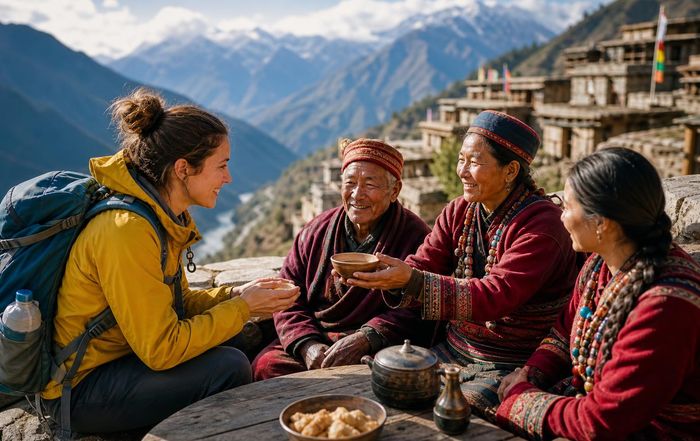
Why Local Culture Matters More Than Ever in Adventure Travel
Adventure travel is often sold as a rush of altitude, speed, and exposure: summits, rapids, singletrack, and remote coastlines. Yet what usually lingers longest in memory is not the gradient of a trail or the difficulty of a rapid, but the people met along the way, the stories shared around a fire, and the sense of stepping into another way of living. That is where local culture moves from background scenery to the core of the experience.
As adventure tourism has grown into a multi-hundred-billion-dollar global industry, questions about authenticity, impact, and ethics have become harder to ignore. For travelers who care about the places they visit-and for communities who live with the consequences-local culture is not a side dish. It is the main course, and how it is treated determines whether an adventure trip is enriching or extractive.
This article explores why local culture matters in adventure travel, how it shapes safety and performance, what "responsible" cultural engagement actually looks like, and how both travelers and operators can move beyond token encounters to genuine exchange.
From landscape to lived place: what "local culture" really means
In adventure marketing, landscapes are often treated as empty playgrounds-mountains without mountaineers, rivers without river people, deserts without pastoralists. In reality, most of the world's celebrated adventure destinations are also long-inhabited cultural landscapes shaped by generations of local knowledge.
"Local culture" in adventure travel usually includes several overlapping elements:
It includes everyday practices-how people work, eat, worship, celebrate, and rest. This can mean the farming rhythms of a Himalayan valley, the fishing traditions of a Pacific island, or the herding cultures that define much of Central Asia and East Africa. These practices often shape the very trails, river access points, and seasonal windows that adventure travelers rely on.
It also encompasses language, stories, and belief systems that describe and interpret the surrounding environment. In many regions, Indigenous or minority communities hold detailed place-based knowledge encoded in oral histories, songs, or spiritual narratives. For instance, UNESCO's work on intangible cultural heritage highlights how rituals, craftsmanship, and traditional ecological knowledge are inseparable from the landscapes where they evolved.
Local culture is also visible in governance and social norms: who makes decisions about land use, how outsiders are welcomed, what counts as respectful behavior, and what is considered offensive. For adventure travelers, these norms can shape everything from whether wild camping is acceptable to how to behave at a village ceremony.
Seeing adventure destinations as lived places rather than scenic backdrops is the first step toward understanding why local culture matters. It shifts the frame from "What can I get from this place?" to "What kind of relationship am I entering into, and on whose terms?"
Culture as a safety system, not just a story
In high-risk environments, local culture is often a practical safety framework. Norms, taboos, and rituals that may look like superstition from the outside can encode hard-won experience of hazards, seasons, and limits.
In mountain regions from the Andes to the Himalayas, local guides and porters often have generations of accumulated knowledge about avalanche patterns, storm behavior, and safe routes. The International Climbing and Mountaineering Federation (UIAA) has repeatedly emphasized how local expertise and cultural familiarity enhance expedition safety, especially as climate change makes conditions less predictable.
In many coastal and island communities, traditional navigation and weather-reading skills-recognized by organizations such as the Polynesian Voyaging Society-offer insights that satellite forecasts alone cannot fully replace. Understanding local practices around tides, storms, or sacred sites can be the difference between a safe sea-kayaking trip and a dangerous miscalculation.
Even seemingly "soft" cultural norms, such as expectations around alcohol, dress, or gender interaction, can affect safety. For example, solo travelers ignoring local advice about where not to walk at night, or climbers disregarding community rules about when to attempt a peak, may find themselves more exposed than they realize. Respectful engagement with local culture is not only ethical; it is a form of risk management.
For adventure planners and operators, this is one reason to prioritize local partners and guides over purely external expertise. Travelers interested in the safety dimension of adventure can find broader context in resources on outdoor performance and risk and adventure safety.
Authenticity, performance, and the quality of the experience
There is a persistent myth that safety and cultural depth are at odds with "serious" adventure, as if time spent learning from local communities dilutes the purity of the climb, paddle, or ride. In practice, the opposite is often true. Cultural immersion can deepen performance and sharpen decision-making.
Endurance athletes who train or race at altitude, for example, often benefit from understanding how local populations have adapted physiologically and culturally to thin air. Studies published in journals such as the American Journal of Human Biology have documented how Andean and Tibetan communities display different high-altitude adaptations, influencing work patterns, rest, and diet. Athletes and adventure travelers who learn from these practices can gain more than they would from imported training plans alone.
Similarly, backcountry skiers in regions with strong avalanche cultures-such as parts of the Alps and North America-often find that local norms around decision-making, group size, and terrain choice are shaped by decades of collective experience and tragedy. Organizations like the Canadian Avalanche Association or national mountain rescue bodies often draw heavily on local historical knowledge in their guidance.
Authenticity also matters on a more emotional level. Many adventure travelers now actively seek experiences that feel grounded rather than staged. Surveys by bodies such as the Adventure Travel Trade Association (ATTA) consistently show growing interest in cultural immersion and community engagement alongside physical challenge. Trips that treat local culture as a living partner rather than a photo opportunity are more likely to produce the kind of transformative experiences people say they want.
For readers interested in how performance and culture intersect in sport more broadly, the performance and culture sections of our site explore similar themes in different contexts.
Economic impact, power, and who gets to tell the story
Adventure travel is often framed as an economic lifeline for remote communities, and in many cases it is. Yet the picture is more complex than "more tourists equals more benefit."
According to the World Travel & Tourism Council, tourism accounts for around 10% of global GDP when direct and indirect impacts are combined. However, how much of that value reaches local communities-especially Indigenous or rural ones-depends heavily on ownership structures, employment patterns, and how trips are designed. Research on "leakage" in tourism by organizations like the UN World Tourism Organization (UNWTO) shows that in some destinations, a large share of tourism revenue flows back to foreign operators, airlines, and investors rather than staying in the host community.
Cultural representation is part of this economic equation. When local culture is packaged and sold to visitors without meaningful local control, it risks becoming a commodity stripped of context. Performances may be adjusted to fit visitor expectations, sacred sites turned into backdrops, and community narratives sidelined in favor of more marketable stories. This can create what some anthropologists call "staged authenticity," where what travelers see is more a reflection of their own fantasies than of local realities.
By contrast, adventure models that support community ownership and leadership-such as community-run trekking routes, co-operatively managed lodges, or Indigenous-owned guiding companies-can help ensure that cultural narratives and economic benefits remain aligned. The Adventure Travel Conservation Fund and similar initiatives highlight community-led projects that connect adventure tourism with local conservation and cultural preservation.
For travelers who care about ethics and impact, this raises practical questions: Who owns the company I am booking with? How are guides hired and paid? Whose story of this place am I hearing, and who is missing from the narrative? Our business and ethics coverage often returns to these questions across different sectors.
Cultural appropriation versus cultural exchange
Adventure travel sits at a crossroads of cultures, gear, and aesthetics. From Maasai-inspired beadwork on surf bracelets to yoga retreats using Indigenous symbols, the line between appreciation and appropriation can be blurry.
Cultural appropriation typically involves taking elements of a marginalized group's culture-such as clothing, rituals, or symbols-without permission, context, or benefit to that group, often reinforcing power imbalances. In adventure contexts, this might look like:
Using sacred symbols or ceremonial dress as costume for social media photos.
Borrowing Indigenous place names or spiritual concepts as branding for lodges, trails, or events without community involvement.
Marketing "tribal" or "primitive" experiences that flatten diverse cultures into stereotypes.
Organizations such as the United Nations Permanent Forum on Indigenous Issues and the UN Declaration on the Rights of Indigenous Peoples emphasize the rights of Indigenous communities to control their cultural heritage and to give or withhold consent for its use.
Cultural exchange, by contrast, is characterized by mutual respect, consent, and benefit. It involves:
Local communities deciding how their culture is shared, on what terms, and with what boundaries.
Travelers approaching rituals, stories, or spaces as guests rather than consumers.
Economic arrangements where communities are compensated fairly for cultural experiences they choose to share.
For adventure operators, this may mean turning down certain kinds of "traditional" performances or staged encounters if communities express discomfort, even if they would be popular with clients. For travelers, it can mean asking before taking photos, buying directly from artisans rather than from anonymous souvenir markets, and accepting that some places or practices are not for outsiders at all.
Climate change, culture, and vanishing adventure landscapes
Climate change is altering many of the landscapes most associated with adventure travel: glaciers are retreating, snow seasons are shortening, coral reefs are bleaching, and river flows are becoming more erratic. These environmental shifts are also cultural shocks, especially for communities whose identities and livelihoods are tied to specific ecosystems.
Reports from the Intergovernmental Panel on Climate Change (IPCC) and initiatives such as Protect Our Winters highlight how mountain and snow sports destinations are already grappling with shorter seasons and increased hazards like rockfall and glacial lake outburst floods. For Indigenous Arctic communities, sea ice loss affects not only travel routes and hunting grounds but also cultural practices and knowledge systems built around ice.
Adventure travelers are often among the first outsiders to witness these changes up close. Engaging with local culture in these contexts can transform climate change from an abstract statistic into a lived story. Guides who grew up on a glacier now retreated by kilometers, or surfers whose home breaks are increasingly affected by storms and erosion, can explain shifts in ways that scientific graphs alone cannot.
For some communities, adventure tourism is becoming a tool to adapt to climate change-diversifying income as traditional livelihoods become less reliable. In others, increased tourism may add pressure to already stressed ecosystems. Understanding local cultural perspectives on these trade-offs is essential for making responsible choices about where and how to travel.
Readers interested in the broader intersection of travel, environment, and society can explore our world and travel coverage, where these themes recur across destinations.
Practical ways to engage respectfully with local culture on your next adventure
The ethics of culture in adventure travel can feel abstract until you are standing in a village square, a mountain hut, or a surf-side café wondering what to do next. A few practical principles can help turn good intentions into better practice.
Preparing before arrival is one of the simplest and most effective steps. Learning basic greetings in the local language, reading about the region's history beyond guidebook highlights, and understanding key religious or social norms can prevent misunderstandings. Resources from organizations like Cultural Survival or country-specific cultural institutes can offer deeper context than standard tourism sites.
Choosing operators carefully is another leverage point. When possible, prioritize companies that:
Clearly partner with local or Indigenous-owned businesses.
Disclose how money flows to communities.
Demonstrate specific commitments to cultural respect, not just generic sustainability claims.
Industry bodies such as the Global Sustainable Tourism Council (GSTC) provide criteria and certification frameworks that can help identify more responsible operators, though certification is not a guarantee on its own.
On the ground, slowing down is often the key to richer cultural exchange. This can mean spending multiple nights in one village instead of rushing through, joining everyday activities when invited, or choosing homestays and community-run lodges over isolated resorts. Simple acts-shopping at local markets, eating at family-run restaurants, hiring local guides-can shift economic benefits and create opportunities for conversation.
Photography and social media deserve special care. Asking permission before taking close-up photos of people, avoiding posting images that reinforce stereotypes or mock local customs, and resisting the urge to geotag sensitive locations can all reduce harm. Some communities now explicitly request that certain ceremonies or sites not be photographed; taking these boundaries seriously is part of being a respectful guest.
Finally, listening more than speaking may be the most underrated adventure skill. Many travelers arrive with strong views about conservation, development, or ethics. Local perspectives may complicate those narratives. Being willing to sit with that complexity-to hear, for example, why a community might support a controversial road project or question certain conservation rules-can be unsettling but ultimately more honest.
Why local culture will shape the future of adventure travel
As adventure travel continues to grow, destinations worldwide are debating how much tourism they want, on what terms, and under whose control. Some regions have introduced visitor caps, new permit systems, or community-led zoning to protect both ecosystems and cultural integrity. Others are experimenting with tourism taxes earmarked for cultural preservation or community projects.
For travelers, this evolving landscape means that "doing it right" is no longer just about packing out trash or offsetting flights. It increasingly involves understanding cultural governance, supporting community-led initiatives, and accepting that some experiences will be off-limits or more structured than in the past.
For communities, adventure tourism can be a double-edged sword: a source of income, visibility, and pride, but also of pressure, inequality, and cultural strain. The outcomes will depend heavily on who gets to define what counts as adventure, what counts as respect, and what counts as enough.
Local culture is where these questions are negotiated. It is the lens through which risk is interpreted, landscapes are valued, and visitors are welcomed or refused. For anyone who cares about sports, adventure, and travel not just as personal milestones but as part of a shared world, paying attention to that culture is not optional. It is the difference between passing through a place and actually being there.